Understanding the project and aerial phenomena
The project#
panpancoucou is an autonomous sky surveillance station, located in southern France (Tarn). Its goal: detect, document and analyse unidentified aerial phenomena with rigour and transparency.
- A wide-angle camera (104°) films the sky continuously, 24/7, day and night.
- Detection is fully automated: every movement in the sky is recorded, classified and cross-referenced with aeronautical and satellite databases.
- The goal is not to prove the existence of non-human intelligence — it's to objectively document what crosses our sky, and isolate what remains unexplained after filtering.
- Source code, data and methods are transparent. The project is self-funded and independent.
How it works#
The system works as a pipeline: each step filters and enriches the data to retain only genuinely interesting events.
The video feed is analysed in real time. Any moving object in the field of view triggers an automatic recording. Parameters (thresholds, minimum area, brightness) adapt to day/night mode.
An algorithm automatically classifies each detection by analysing trajectory, speed and visual characteristics:
- Aircraft — linear trajectory + OpenSky confirmation (callsign, altitude)
- Satellites — correlation with TLE ephemerides (Celestrak) and known orbits (ISS, Starlink...)
- Birds — multi-contour patterns, erratic movements (disabled at night)
- Bats — serpentine/sinusoidal trajectory in night mode (insect hunting)
- What doesn't match any known pattern stays classified as "detection" — to be analysed manually.
The "Traces" tab in the event list gathers all identified passes (aircraft, satellites, birds). It serves an educational purpose: it helps you learn the visual signatures of known objects — trajectories, speeds, brightness — so you can better recognise what is normal in the sky, and better appreciate what isn't.
Each event is cross-referenced with two real-time databases:
- OpenSky Network — worldwide air traffic (callsigns, positions, altitudes)
- Celestrak TLE — satellite orbit catalogue (propagation with SGP4/skyfield)
If a known object matches the position and time of the detection, it is automatically identified and tagged.
Every event is manually reviewed by an operator. Identified traces (aircraft, satellites, birds) are confirmed or corrected. Three types of events are kept:
- The unexplained — what remains after filtering, documented with clip, metadata and weather context
- Educational examples — flocks of birds, aircraft contrails, satellite passes... to show what the system captures and reveal the richness of the sky
- Aesthetic moments — moon through clouds, atmospheric phenomena, remarkable natural light. The sky sometimes offers striking images, even in black and white
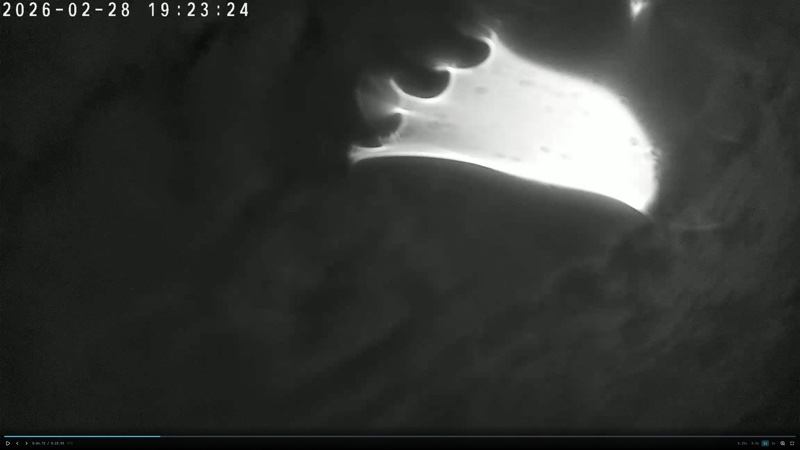
Évènement #2252 — lune émergeant des nuages, halo lumineux 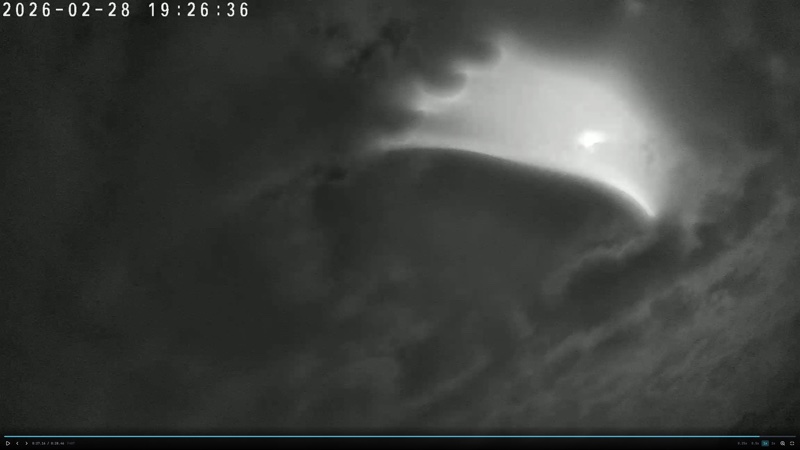
Évènement #2255 — arc lunaire à travers la couverture nuageuse 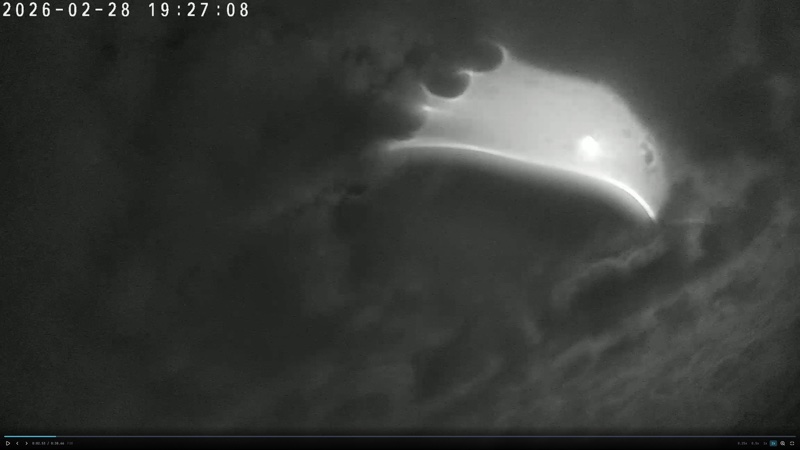
Évènement #2256 — croissant de lune et jeux de lumière
Weather conditions (temperature, humidity, cloud cover, wind, visibility) are automatically captured at each detection via the Open-Meteo API. They help contextualise observations.
Simplified pipeline #
Camera → Motion detection → Auto classification → Sky ID → Human validation
Understanding the phenomena#
UAP (Unidentified Aerial Phenomena) in English, PAN (Phénomènes Aériens Non-identifiés) in French — same concept, and the official term replacing "UFO" or "OVNI". It refers to any observed aerial phenomenon that cannot be immediately identified. In France, GEIPAN (part of CNES) has used the term PAN since the 1970s. In the US, the Pentagon and NASA adopted UAP. The name panpancoucou is a direct nod to this term.
The vast majority of detections are perfectly identifiable objects:
- Commercial and private aircraft (confirmed by OpenSky)
- Artificial satellites — ISS, Starlink, and thousands more (confirmed by TLE)
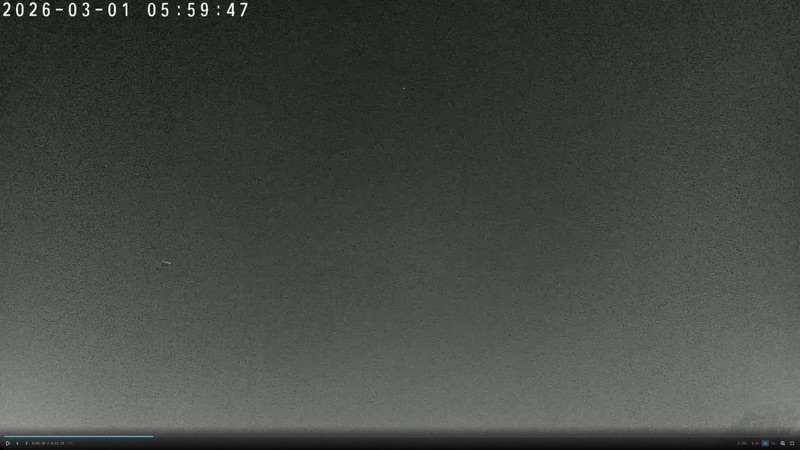
Évènement #2448 — Starlink-32898 entrant dans le champ, non identifié automatiquement 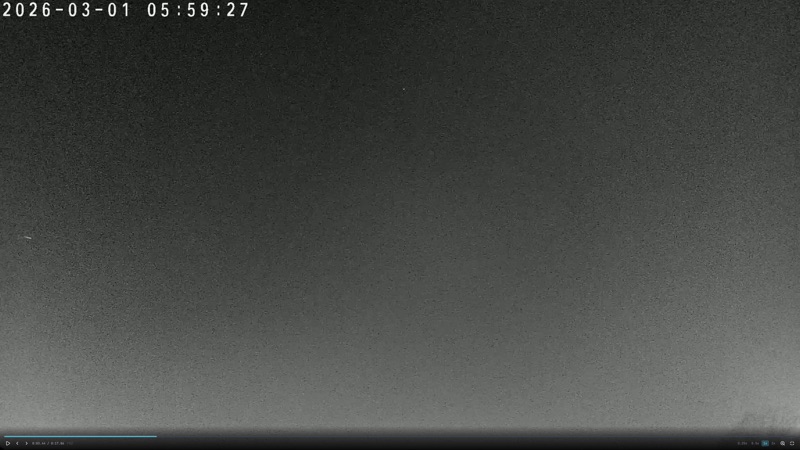
Évènement #2449 — même satellite 20s plus tard, identifié comme STARLINK-32898 par TLE - Birds, bats (especially at dusk)
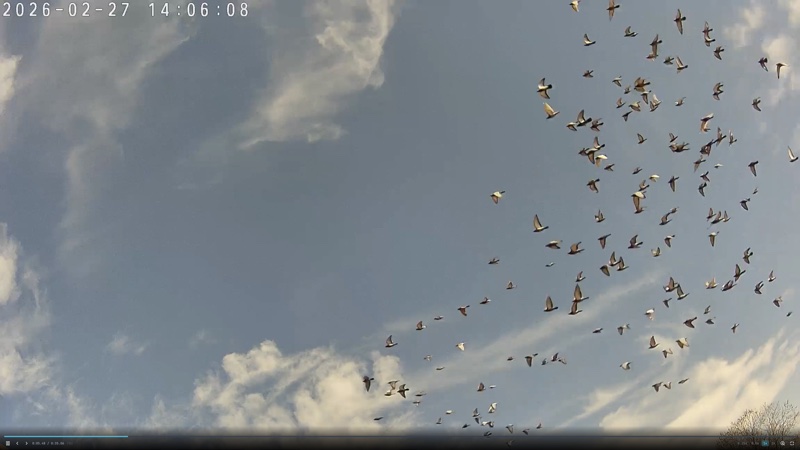
Évènement #775 — banc en vol 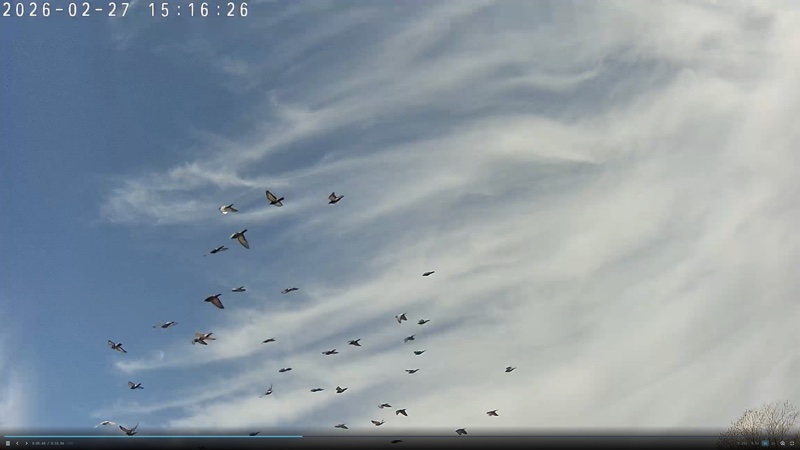
Évènement #813 — formation 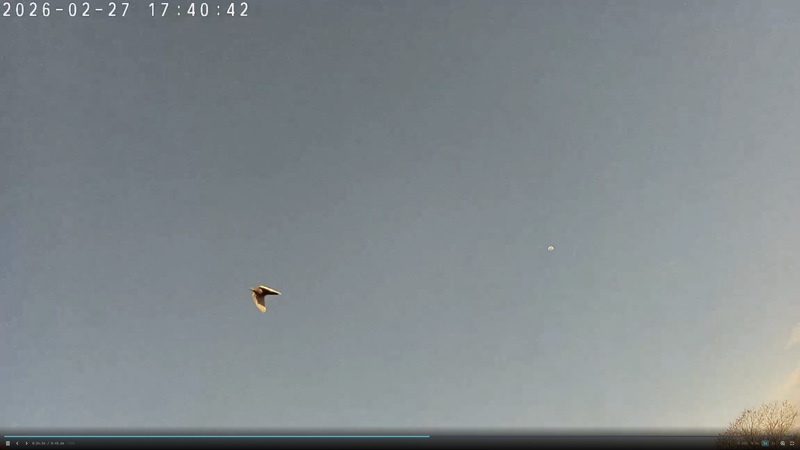
Évènement #921 — rapace isolé, lune et avion commercial en fond - Meteors, shooting stars (brief luminous passages)
- Optical artefacts — reflections, insects near the lens, sensor noise
Before concluding that a clip shows something unexplained, you need to know the optical and technical phenomena that create false positives. Here are the most common ones:
- Hot pixel — fixed bright point, always at the same position, mostly visible in night mode. CMOS sensor defect, worsened by heat. Distinguished from a real object because it never moves between frames.
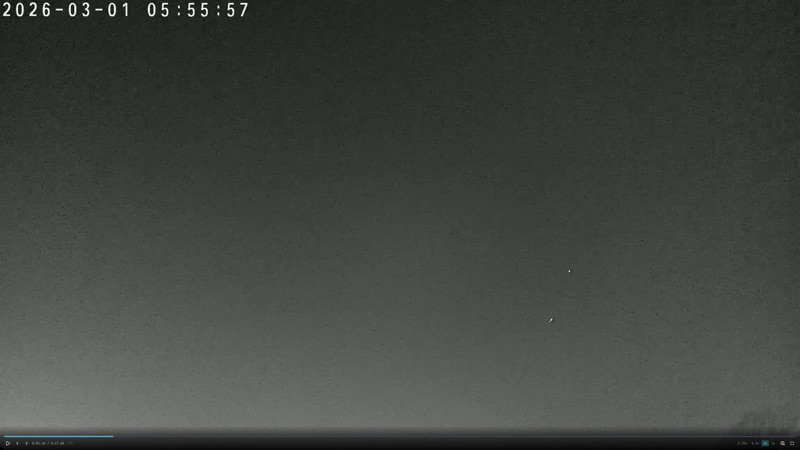
Évènement #2441 — deux pixels chauds fixes visibles à l'aube (gain capteur élevé) - Lens flare — ghost spot or point symmetric to an intense light source (moon, streetlight). Disappears if the source is occluded. The moon through thin clouds can create 2 to 4 simultaneous ghost reflections.
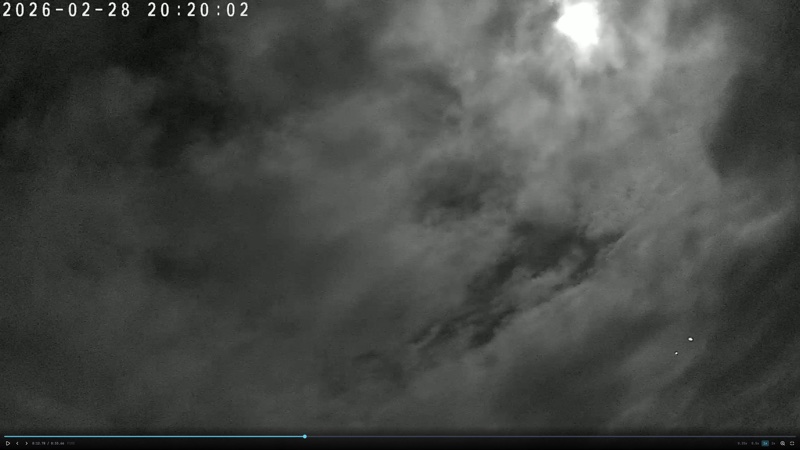
Évènement #2274 — lune derrière les nuages, point lumineux suspect 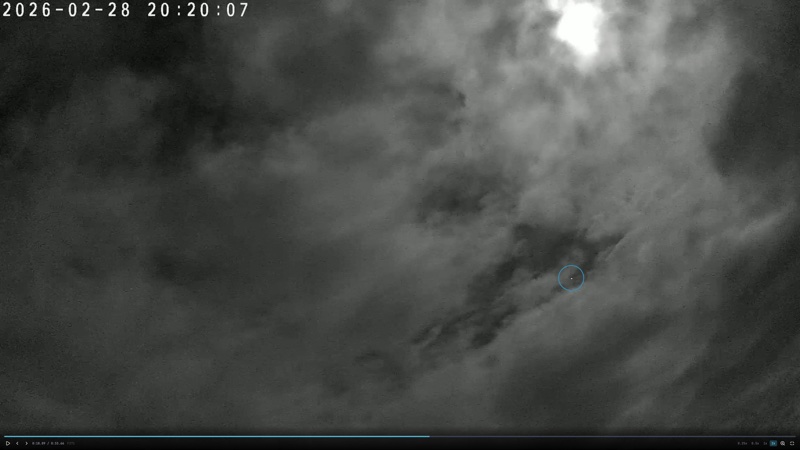
Évènement #2274 — 5 secondes après, même zone 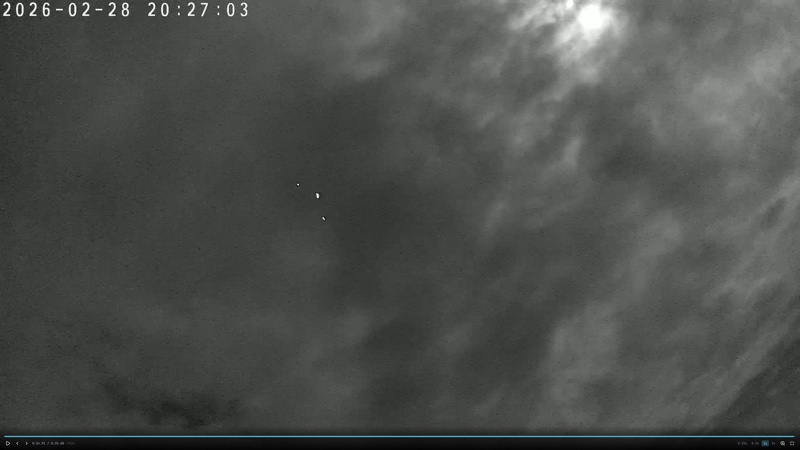
Évènement #2285 — points lumineux symétriques à la lune - IR sensor noise — random scintillation of points in night mode, caused by high gain. Typical brightness 40-72 (real objects exceed 80). Filtered by detection thresholds.
- IR halos — diffuse bright area created by the camera's infrared LEDs reflecting off the lens or nearby surfaces. Fixed position, circular shape.
- Insects — attracted by IR heat, very close to the lens so blurry and disproportionately bright. Erratic movement, sudden direction changes. More frequent in summer.
- Bats — active from dusk (March to October in France), characteristic serpentine/sinusoidal flight pattern while hunting insects. Unlike insects: the object is sharp (in the focal plane, so at distance), single contour, and the trajectory undulates around a general direction rather than being chaotic. Illuminated by moonlight in night mode. Typical duration: 5 to 15 seconds across the field of view.
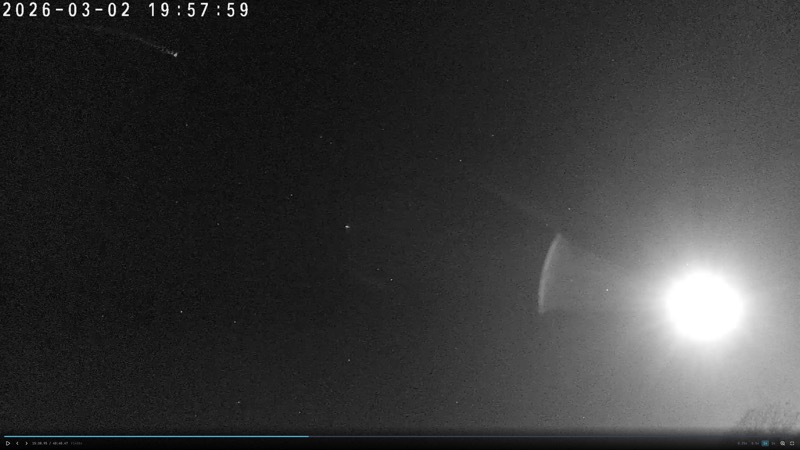
Évènement #2915 — chauve-souris, trajectoire serpentine, arrivée par le haut-gauche 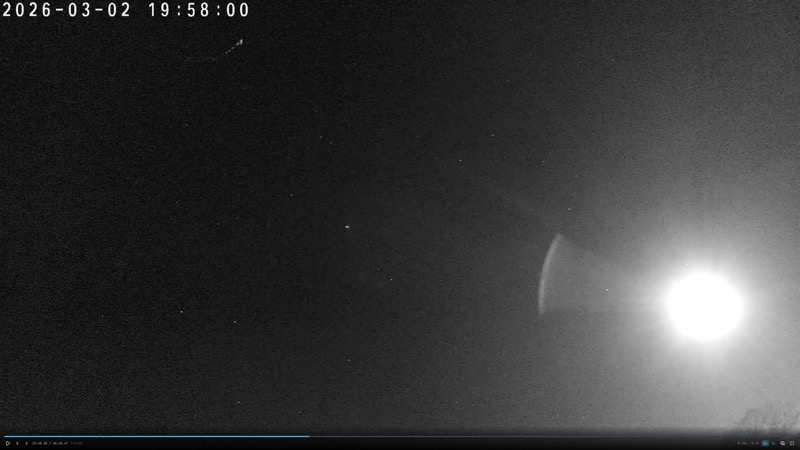
Évènement #2915 — oscillation visible au centre du champ 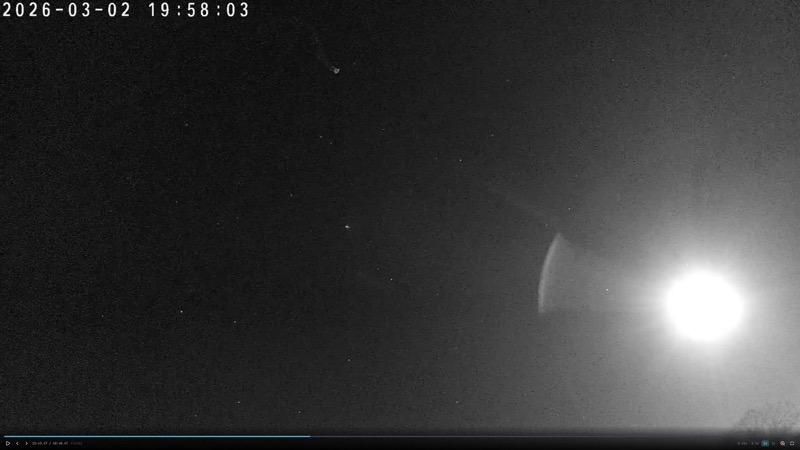
Évènement #2915 — fin de trajectoire vers la droite, proche de la lune - Contrails — only visible when the aircraft flies above approximately 10,000 m in humid atmosphere. Below that, or in dry weather, the aircraft is often invisible on camera despite being confirmed by OpenSky.
- Head-on aircraft — a plane flying towards the camera appears stationary for several seconds (no lateral movement). Its 3 navigation lights (red, green, white) can resemble a "formation" of light points.
- Dome condensation — droplets acting as micro-lenses that diffract IR light. Appears gradually in cold, humid weather, disappears in sunlight.
- Compression artefacts — square blocks (8x8 px) appearing for 1-2 frames during sudden brightness changes. Caused by H.264 compression of the RTSP feed.
Golden rule
If a phenomenon is fixed, symmetric to a source, blurry, erratic or lasts 1-2 frames — it's almost certainly an artefact. What's interesting is sharp, moving steadily, and not correlated with any database.
What remains after filtering — events matching no known aircraft, satellite, bird or artefact — constitutes the real UAPs. They are rare but systematically documented: video clip, metadata, weather conditions, sky position.
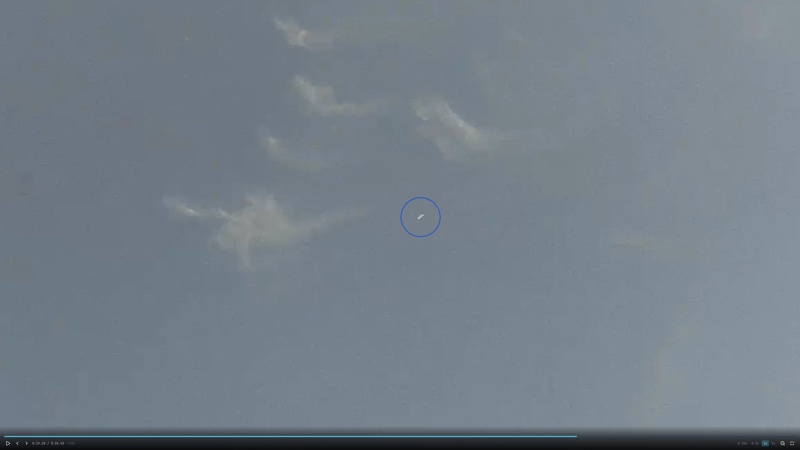
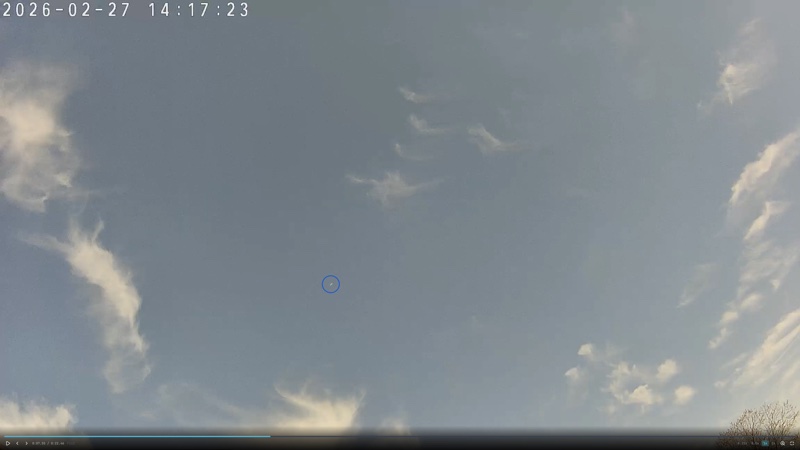
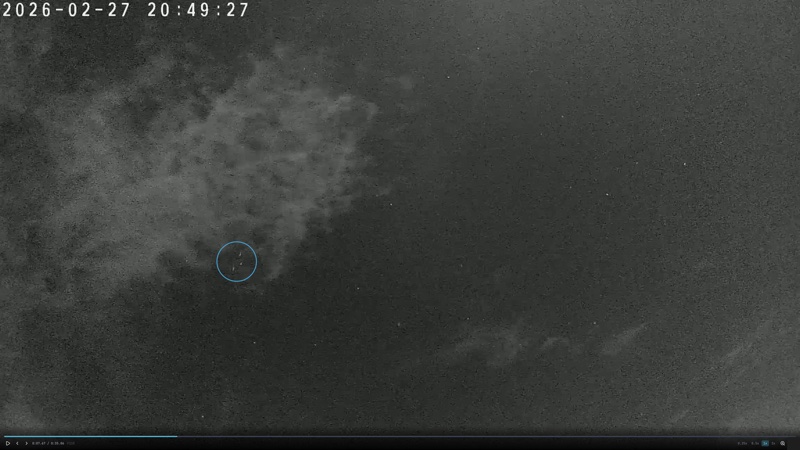
The approach is scientific: methodically eliminate the known to isolate the unknown. No sensationalism, no hasty conclusions. An unidentified event doesn't mean "extraterrestrial" — it means "we don't know yet".
UAP research has become a serious field of study worldwide:
- AARO (USA) — All-domain Anomaly Resolution Office, created by the Pentagon in 2022
- GEIPAN (France) — Group for the study of unidentified aerospace phenomena, part of CNES
- Galileo Project (Harvard) — academic research programme led by Prof. Avi Loeb
- NASA — official report published in 2023 recommending a systematic scientific approach
- Japan — parliamentary group dedicated to UAPs created in 2024 (UAP Clarification League), supported by the Ministry of Defense
- Canada — Sky Canada project (Office of the Chief Science Advisor), 2025 report recommending the creation of an official UAP reporting office
Contribute and support#
Request observer access to view real-time data: events, video clips, classifications, live stream.
Report your own observations, enrich analyses, suggest improvements. The project moves forward thanks to community feedback.
The project runs entirely on personal funds — development, hardware, hosting. Every contribution helps improve the system's reliability, deploy new stations at private homes or community sites, and strengthen our ability to detect what remains unexplained in the sky.
- AI / Machine Learning — automatic visual recognition (YOLO) to identify birds, aircraft, satellites directly from the image
- Multi-station — deploy a 2nd station to enable triangulation (distance, altitude, true speed)
- YouTube channel — public showcase with the most interesting clips, commented and analysed
Want to get involved? Head to the Contribute page.
Contribute →